Saturday, 18 April 2009
April Wine in Revew

Friday, 10 April 2009
Vino Mexicano
The area’s Mediterranean climate allows several varietals to thrive, including Chenin Blanc, Sauvignon Blanc, Chardonnay, Cabernet Sauvignon, Merlot, Syrah, Tempranillo, Nebbiolo, Grenache, and the list goes on. Mexico only produces a few million cases each year, with about half of that coming from L.A. Cetto, a Guadalupe Valley mega-producer. L.A. Cetto (pronounced “la chetto”) experiments with 67 varietals, presumably still trying to find the perfect grapes for the soil and climate.
Wine isn’t as new to Mexico as you might presume. Vineyards werefirst planted by Spanish missionaries in the late 1500s, although it wasn’t until the 1800s that the Guadalupe Valley area was planted with the capability for sizeable production. The industry has boomed in recent years, although it is still trying to find its way onto the global wine map. Recently, there was a Wines of Baja tasting held in San Francisco, so the word is spreading fast, but the region needs to overcome significant geographical and historical prejudice before the wine world starts to take them seriously.
I tasted at L.A. Cetto and Casa Pedro Domecq, whose tasting rooms are just down the road from each other, only a 30 minute drive from Ensenada. Tasting fees are low ($3-5) and the ranges I tasted were surprising. Domecq’s tasting offerings illustrate how the lack of local wine regulation encourages experimentation, as I tasted a Chenin Blanc/Chardonnay blend, a Grenache Rose, and a Merlot, Cabernet Sauvignon and Nebbiolo blend. None of them were outstanding, but the majority of them were quite good, and I even bought the bottle of Chateau Domecq as a souvenir wine (which paired well with marinated and barbequed tri-tip over the weekend).
 L.A. Cetto offers more single varietals, such as a pleasing Viognier, a food-friendly oaked Chardonnay, a very good Bordeaux blend, and a well-balanced Cabernet Sauvignon Rose. Both vineyards provide tours of the facility and have modern and spacious tasting rooms. It would be interesting to have had time to visit more boutique wineries, which I imagine would involve a lot of knocking on doors to have a taste rather than rocking up during any established and well-organised tasting hours.
NZ wine tasting stats
- Over the course of two months, I tasted (and wrote notes) on nearly 250 New Zealand wines, representing over 50 different wineries. Most of these were either at wine festivals or on wine tasting tours, but I did jot down tasting notes whenever I could at a restaurant or bar as well.
- Of the wines tasted, the greatest majority were Pinot Noir (65), then Riesling (35), Sauvignon Blanc (30) and smaller quantities of other varietals such as Chardonnay, Pinot Gris, and red single varietal or blends. These numbers reflect my taste more than the actual ratios of NZ wine production, but of course, Pinot Noir and Sauvignon Blanc are what have given NZ it's international reputation.
- My scoring distribution is divided as follows: I gave 12% an "excellent", 35% "very good", 36% "good" and 17% either an OK, non-rated, or bad (as in there is something actually wrong with the wine). I haven't decided yet if these ratings are perhaps too generous or a fair distribution. It's not fair to re-rate in hingsight, but if I was on the fence (good/very good) I gave it the lower rating when entering the scores.
- I tasted in all the major wine regions, including Auckland (Waiheke Island), Hawke's Bay, Martinborough, Marlborough, Nelson, and Central Otago. The only wine region I didn't explore much was Gisborne, on the north island. Since they are known mostly for their Chardonnay, it wasn't a high priority for me.
I will post more on specific regions and wineries, but in the meantime, feel free to ask me any questions about a specific wine you may have seen in your supermarket or wine store. There is a good chance I can tell you what it tastes like before you decide to buy it!
Thursday, 2 April 2009
Revisiting California Pinot Noir and...a Conundrum
 We opened the bottle on Sunday night, and it was definitely the best of the three bottles we brought (2004 Jordan Cabernet Sauvignon and Caymus Conundrum* being the other two). The aromas were black cherry, jammy, and bright berries. It was definitely ready to drink and paired excellently with my mushroom soup starter and my norwegian salmon main. Everyone at the table loved it, and I was glad I had saved it for a semi-special occasion.
 To close the gap in my cellar, I also purchased an Etude Carneros Pinot Noir from '05 so that I can do a vertical tasting with the '04/'05 at a later date.
*I've had two Caymus Conundrums in the past week - a 2007 and a 2006. Both vintages teetered on the edge of an off-dry riesling more than the predominant Chardonnay, Sauvignon Blanc, and Viognier blends that I recognise from previous years. The website indicates that the blend of grapes is still true to its roots, but maybe there is more Muscat in recent vintages to give it the higher sugar content? Either way, I still thoroughly enjoy this wine, and consistently find it to be a crowd-pleaser and to pair with a variety of foods. I trust Caymus on this one, but I am still really curious to know what's inside the bottle!
Wednesday, 1 April 2009
My Top 4 NZ wines
I (mostly) restrained from buying bottles until the very end of my two month trip. Bottles I bought along the way were consumed along the way or given as gifts. In the end, I only brought back reds with me, the main logic being that reds are the wines you cellar and age, and that's what I wanted to do with my purchases. It's harder to get as excited about a white wine, even though I did discover some fantastic ones in the form of off-dry Rieslings and of course Sauvignon Blancs.
Here are the four wines I purchased, and a bit of background as to how I discovered and chose this particular wine:
2007 Mt. Difficulty Pipeclay Terrace Pinot Noir: The bouquet has strong floral notes (dark red roses and lilac according to the vineyard), with dry dirt, earthiness and hints of chocolate. All very impressive flavours for a young Pinot Noir. In fact, I don't think I need to hold on to this one for more than a few years. It will be in the category of ready to drink when I am ready to drink it.
I tasted this wine at Wine Taste in Queenstown, one of those wine dispenser tasting stores that can be a great substitute for visiting the vineyards themselves. I did taste in Central Otago, but only in the Gibbston Valley area, just outside Queenstown. After looking forward to Central Otago Pinots my entire trip, I was disappointed with the Pinots I had at Gibbston Valley Vineyard, Waitiri Creek, Chard Farm and Amisfield. They were good, but not great. Mt. Difficulty is farther east in the Bannockburn area, where prestigious wineries such as Felton Road and Akarua are based.
Price: $90 NZD in country ($53 USD or 36 GBP equivalent). International distributors here.
2007 Nautilus Four Barriques Pinot Noir: I first tasted this wine at the 2009 Marlborough Wine Festival in Blenheim at the Nautilus booth. It was the only wine that day that I purchased a second tasting of and in a full glass size. I thought my enthusiasm for the wine might just be the wine talking until I tasted it again first thing the next morning at the vineyard itself. It was just as good, with raspberry flavours and oak or cedar spice. A terrifically well-balanced wine, it was on my favourites list.
Both events were only halfway through my trip, so I wasn't able to purchase and carry the bottle with me at the time. When I was making my final wine decisions during my last week, this wine still came back to me, so I had my friend, Annette, ship it to me. Oddly enough, she is renting a room in Blenheim from the marketing director of Nautilus, so it was fairly easy for her to procure a bottle and ship it to my hostel in Christchurch only a few days before I left the country.
Price: $60 NZD in country ($35 USD or 24 GBP equivalent). This wine is not distributed outside New Zealand, however Nautilus also makes a very good Sauvignon Blanc and regular Pinot Noir. International distributors here.
2006 Ata Rangi Celebre: This is a 50% Merlot, 30% Syrah, 20% Cabernet Sauvignon with excellent white pepper and tobacco reminiscent of Northern Rhone Syrahs. Fruit flavours of dark plum and bright berries round out a fantastic wine to pair with steak or rich sauce pastas.
I drank this wine quite a bit during my stay, first at the vineyard in Martinborough where I purchased a bottle, then later on that night when I shared the bottle with fellow wine travellers, again at dinner with a friend in Queenstown and finally at Wine Tastes, just to confirm my choice. At $32 NZD retail, it is a good value and very enjoyable. See reviews from well-known wine critics here. I have also enjoyedthe 2007 Ata Rangi's Crimson Pinot Noir.
Price: $32NZD in country ($19 USD or 13 GBP equivalent). International distributors here.
2004 Alpha Domus "The Navigator": A Bordeaux-style blend from Hawke's Bay on the North Island, the Navigator is well-structured but drinkable now. It contains Merlot, Cabernet Franc, Cabernet Sauvignon and Malbec. As published in Hawke's Bay Today Sip of the Week: "It's almost a crime to have this wine shut away in a bottle - there should be enormous open vats of it out in the public spaces for us to all swim around in."
I tried this wine at the vineyard at the 2009 Hawke's Bay Wine Festival, noting that it was excellent (as was the similar "Aviator" although at a $45NZD price tag). I was pleasantly surprised to find it during my last week in the country, and I look forward to opening this in the near future (I don't think I can wait!)
Price: $25 NZD in country ($15 USD or 10 GBP equivalent). International distributors here.
Thursday, 16 October 2008
London Wine Bars
Gordon's Wine Bar - famed for being the oldest wine bar in London, Gordon's has ambiance (underground brick cellar), good wines and always a packed crowd. It's centrally located between Embankment and Charing Cross and a great place to meet someone for a first date where the guy might be a dud, but the wine will make up for it!
Cork & Bottle - Surprisingly located in touristy Leicester square, the Cork & Bottle even more surprisingly is down a spiral staircase next to a sex shop. It doesn't offer a full menu of food, but does have tasty selections of cheeses and other nibbles. The wines-by-the-glass menu is posted on chalkboards around the main bar and it always provides a range of classics and interesting wines to try. The wines by the bottle menu is geographically organised and has a fantastic variety of wines. This is a great place for 2-4 people, especially if you can get the nook under the curved brick-cellar style ceiling. Because of it's convenient location, I've often stopped in after a show and usually can get a table. It's very cosy, so great for the winter months to settle in with a bottle and good conversation with friends.
Vinoteca - I love this place. I recently discovered it with a friend in August and have been back three times since then. It's first and foremost a wine bar, with intriguing wines by the glass (such as Navarra Garnacha Rose and Chilean Carmenere). The wines by the bottle list is extensive and affordable and all wines can be purchased to take home since it's a wine shop as well!). Secondly, it's a great restaurant with wine suggestions paired with every course. The ambiance is casual, with wood floors, tables and chairs in a small dining area. Located in Barbican/Farringdon, it's convenient to get to from Farringdon tube and there are several other excellent bars and restaurants in the area for starting or ending the night.
Bedales, Borough Market - Another well-designed wine bar/wine shop, Bedales is centrally located at London Bridge in Borough Market. The wines by the glass list is short but with appropriate selection. The best feature is that you can buy any bottle in the shop and drink it onsite for only 8 GBP more. This is a great value way to try a bottle of red over a cheese or charcuterie plate. There is bar stool seating in the main area, outdoor seating with old barrels as tables and additional seating downstairs, so there is generally room to squeeze a few more people in.
The Providores and Tapa Room - The Tapa Room is a New Zealand wine bar and tapas-style restaurant on ground floor the cozy location on the Marylebone High Street. Although on the pricey side for a meal, it's a great place to try NZ wines and chat and drink over a few tapas as a snack. The venue is very small and does fill up fast, so best to arrive on the early or late side. I haven't tried the first floor restaurant, The Providores, but I reckon that it would be fantastic.
Spirit tasting
I felt the awe of realising how little I knew about the distillation process or how you could actually make alcohol out of nearly everything it seems (fruit, potatoes, barley, etc). I also realised how little I knew about how vodka differs from gin, for example (very little is seems. Gin isn't much more than flavoured vodka where the predominant flavour must be juniper berries). And then, on the test, I probably got most of the spirit-related questions wrong. I couldn't remember the colour of reposado tequila, or which ingredient was the basis of rum.
All of this on my wine blog is to say that it's true that the more you learn about something, the less you realise you actually know. For now though, I'll stick to the topics I already have a head start on...
Wednesday, 30 July 2008
Tasting: Spanish White Wines
Sunday, 13 July 2008
Vinoteca, London
7 St. John Street
London EC1M 4AA
http://vinoteca.co.uk
Amongst other things, such as finally meeting a virtual friend in person, Saturday provided me with a new appreciation for the "wine bar," a term that is so liberally used that I no longer have faith in Google search results for such labelled places in London or other cities that I travel to. It seems that too many chain pubs or bars somehow think that by simply combining the sale of wine with the venue of a bar, they are allowed to market themselves as such. Tsk tsk.
Before I sing the praises of Vinoteca, where I dined and drank most of Saturday afternoon away, let me propose an illustrative wines-by-the-glass list at an typical establishment which too liberally labels itself as a wine bar.
Whites by the Glass
- Pinot Grigio, vintage and producer name optional
- Silly-named kangaroo-related Australian Chardonnay
- A Sauvignon Blanc from a warm climate region, or a Viognier from a cool climate region
- A token glass of Riesling
- Californian single-varietal, such as a Merlot or Cabernet, by a producer the size of which could flood the Thames with their annual production and at the price 4x what it should be at the bottom shelf of a supermarket.
- French Burgundy at the bottom of the price threshold for that style of wine and surely a name you've heard of before because Tesco had it on sale last week.
- Unnamed Cotes-du-Rhone, from the latest vintage (i.e. barely drinkable yet)
- Token Australian Shiraz
- Spanish Rioja, Argentinian Malbec or Chilean Cabernet for "variety"
A wine bar should be an oenophile's heaven, providing an array of varietals, styles and regions (by the glass as well as by the bottle) that will intrigue and challenge any wine lover. It should have some crowd pleasers, such as a recognizable varietals, but also offer palate-provoking variations. This is where Vinoteca wins my approval.
Located on St. John Street in the Islington area of London (just around the corner from Farringdon tube), Vinoteca is a casual wine bar, restaurant and wine merchant. Its wines by the glass list is intriguing enough that my companion and I never felt the need to stray to the bottle list for inspiration.
Tasted:
- 2007 Arneis, by Coopers Creek, Gisborne, New New Zealand - Aromatic sweetness of a peach, but a bit short on the finish, with a tartness that did start to ease up as the wine breathed. One suggestion is that this wine needs a bit more time in the bottle to grow into its own.
- 2006 Navarra Garnacha Rose 'Artazuri' from Artadi, Spain - Beautiful strawberry colour and nose, with great structure from the Grenache. Strong acidity paired excellently with the the spicy lobster linguine.
- 2004 Cadillac from Chateau Fayau, Bordeaux, France - Sauternes-lite, with all the typical honey and viscosity you'd want in this style wine.
- Salad of Roasted Figs, Creamed Feta, and Pesto
- Lobster, Chilli, Tomato and Parsley Linguine
- Cheese Plate of English Cheeses
A browse through the wine merchant corner of Vinoteca showed a promising selection of over 275 wines. I felt the need to restrain myself from buying anything, not least because I was heading to a music festival and I already have over 50 bottles of wine at home that need to be drunk in the next two months. The selection was tempting...
All the food was excellent, allowing this wine bar to be a place you could settle into for the day, or the evening, or heck, can I just move into a room above the bar?
Well done, Vinoteca. I look forward to when we meet again.
Sunday, 9 March 2008
February's Tasting: California Reds
We had a full house of 10 people, which I've determined is the maximum number of guests I can comfortably host with everyone having the basics, like a chair :) To eat, we started with cheese and crackers. With six planned wines to get through, I served an appetizer of marinated beef skewers to go with the first three wines, and a simple but tasty pasta dish with sausage and lots of veggies with the second three wines. A final addition of a Rhone-style blend was added towards the end of the evening.
We drank:
- 2003 Hannah Merlot, Sonoma County ($20)
- 2003 Qupe Syrah Central Coast, Santa Ynez Valley
- 2004 Bonny Doon Vineyards Carignane "Ancient Vines", Central Coast
- 2003 Pipestone Mourvedre (£15)
- 2003 Zahtila Zinfandel Laura Zahtila, Sonoma, Dry Creek Valley
- 2003 Peju Province Winery Cabernet Sauvingnon, Napa Valley (£15)
- 2003 Bonny Doon Le Cigare Volant (Rhone-style blend), Central Coast
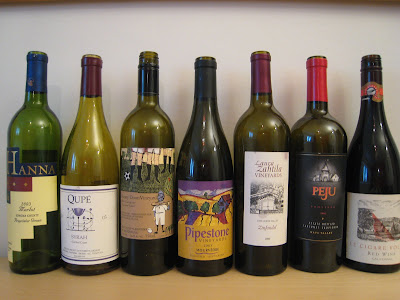
Nearly all the wines were the 2003 vintage, which although purposeful, was probably not noticed by anyone. We weren't trying to do a detailed comparison tasting between the varietals, but it was more demonstrative of "this is what California can produce" and it doesn't hurt that 2003 was a good year. The wine was well-received, and it was such a nice change of pace for me to be able to have an evening of yummy California wines, nearly all carried over from the U.S. in various suitcases over the past year.

